
Lorem ipsum dolor sit amet, consectetur adipiscing elit. Ut elit tellus, luctus nec ullamcorper mattis, pulvinar dapibus leo.
Silent Hacking: The Hidden Enemy Threatening Small Businesses
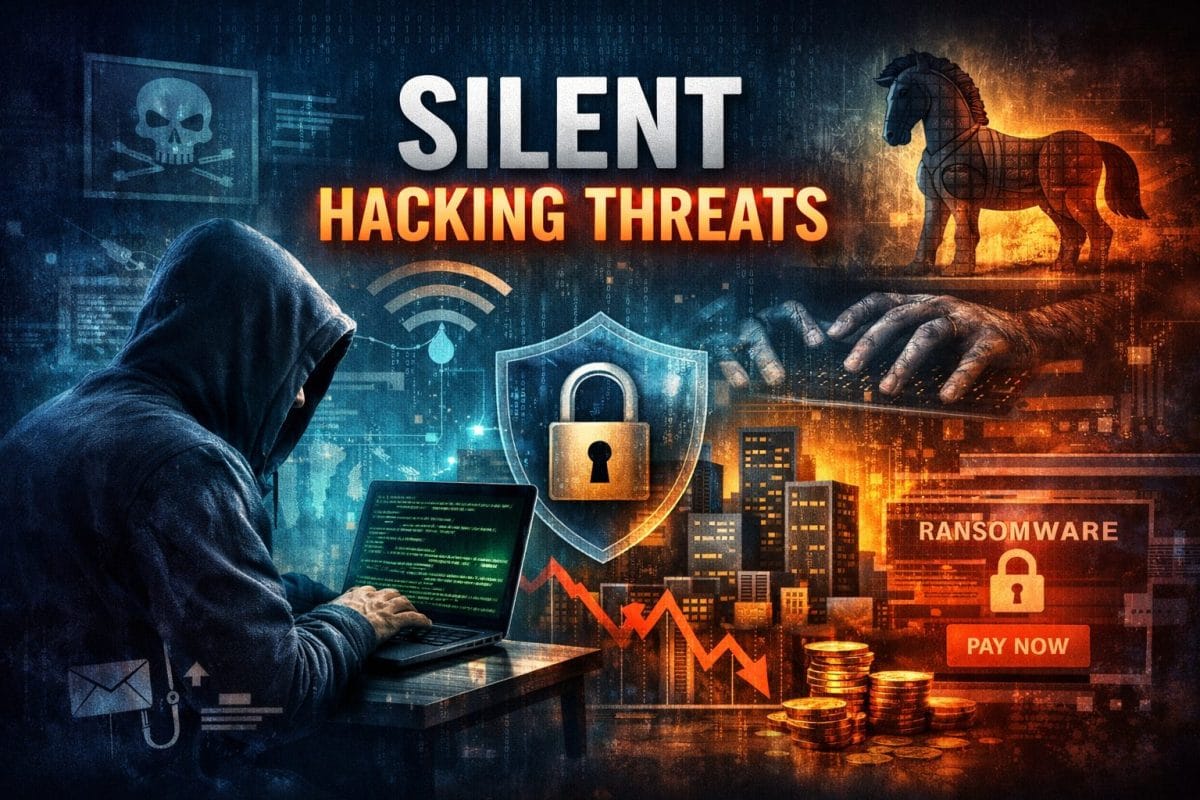
Silent Hacking is the invisible enemy in today’s digital business environment. Cyber threats are no longer limited to loud attacks that crash systems instantly and announce themselves clearly. The real danger lies in attacks that make no noise, cause no immediate disruption, and leave no clear alerts. Imagine an intruder inside your company network for weeks, or even months. They don’t tamper with files or settings in obvious ways. Instead, they observe silently: monitoring financial transactions, reading internal communications, and mapping customer data meticulously. This is the essence of Silent Hacking — a stealthy form of attack aimed at surveillance and prolonged undetected access.
The main risk of this type of attack is not the moment of intrusion itself, but the duration it remains unseen. In cybersecurity reports, this period is called the Dwell Time, which measures how long an attacker stays in a system before detection. According to IBM’s annual reports, the average dwell time can exceed 200 days. During these months, the attacker becomes more than just a visitor… they become part of the family.
Contrary to popular belief, this scenario is not exclusive to large enterprises. Global cybersecurity statistics indicate that nearly 43% of cyberattacks target small and medium-sized businesses. The reason is not just the value of the data but also the ease of remaining undetected, due to limited security resources and the false assumption that “we’re too small to be noticed.” Many small business owners in Egypt assume they are outside the threat radar: “We’re a small company; no one is looking at us.” This assumption is exactly what makes Silent Hacking effective — and extremely costly once discovered.
From this point, the question is no longer: Will a hack happen? But rather: How long could it remain unnoticed? For cybersecurity for small businesses in Egypt, this is the most critical challenge today.
Common Types of Silent Hacking Threatening Small Businesses
A common misconception is that cyberattacks follow a single pattern. In reality, skilled attackers use multiple methods to maximize the time they remain undetected.
The common thread in silent attacks is stealth and persistence — the longer an intruder remains hidden, the greater the potential damage.
Here are four of the most dangerous types of silent hacking frequently affecting small and medium enterprises:
1️⃣ Dormant Ransomware
Many associate ransomware with instant file encryption and an immediate ransom demand. However, in Silent Hacking scenarios, the ransomware attack often begins weeks or months earlier.
During this dormant phase, the attacker:
Maps the company’s data structure
Identifies critical systems
Locates and tests backups
Explores response mechanisms quietly
No files are encrypted, and no alerts are triggered. Everything appears to function normally while the attacker prepares for a single decisive strike that could cripple the company.
The danger lies not in the ransomware itself but in the surprise factor:
Backups may be inaccessible
Recovery time may exceed operational tolerance
Lorem ipsum dolor sit amet, consectetur adipiscing elit. Ut elit tellus, luctus nec ullamcorper mattis, pulvinar dapibus leo.
2️⃣ Slow Data Exfiltration – A Silent Hacking Strategy
This is the core of Silent Hacking. Instead of stealing large amounts of data at once — which would trigger monitoring systems — attackers extract small amounts gradually over months.
Data targeted often includes:
Client lists
Internal communications
Pricing proposals
Operational or design documents
Nothing seems wrong at the time. No system crashes, no noticeable slowdown. But over time, the results are clear:
Competitors move suspiciously in advance
Your proposals appear pre-empted
Unique advantages disappear silently
3️⃣ Man-in-the-Middle (MITM) Attacks – A Silent Hacking Technique
In Silent Hacking scenarios, the attacker does not breach systems directly but intercepts communications between two parties who believe they are communicating directly. They secretly position themselves between:
The company and a supplier
The company and a client
Employee and internal system
This allows attackers to:
Intercept messages
Steal sensitive credentials
Modify communications
Redirect payments unnoticed
The attack may not require system breaches — a compromised endpoint or insecure network may suffice.
4️⃣ Cryptojacking (Resource Exploitation) – A Silent Hacking Threat
Sometimes the goal is neither data nor disruption but economic gain. In Silent Hacking scenarios, cryptojacking occurs when the attacker leverages company devices to mine cryptocurrency without permission. There’s no encryption or ransom message.
Signs may include:
Gradual slowdown of devices
Excessive resource consumption
Unexpectedly high electricity or hosting costs
Often misinterpreted as aging hardware or heavy workload, while the real culprit is a Silent Hacking attacker draining computing power.
📌 Section Summary
The common factor among these four types is time. The longer the attacker remains undetected, the higher the eventual cost. The next logical question: What happens when Silent Hacking is finally discovered?
Direct Costs: The Heavy Price of Silent Hacking
Once discovered, silent hacking does not appear as a single event but as a cascade of accumulated losses.
Immediate Financial Losses
- Unauthorized bank transfers
- Ransom demands
- Direct monetary theft
The danger is that losses are not from one mistake but a carefully timed attack exploiting the long dwell time.
Technical Recovery Costs
Remediation requires more than removing malware. Companies must:
- Trace the breach origin
- Determine compromised data
- Check for backdoors
- Engage forensic experts
This process is often time-consuming and costly, especially because silent hacking leaves few obvious traces.
Regulatory and Legal Liabilities
Increasing regulatory pressures mean data breaches can result in:
- Heavy fines
- Legal claims from clients
- Compliance obligations
In Egypt, with personal data protection laws active, companies are fully responsible for securing customer data. Legal consequences are separate from technical recovery.
Section Summary
Direct costs are measurable but substantial. The real challenge is that most damage occurs before discovery, making delayed responses far more expensive.
Indirect Costs: The Deep, Lasting Wounds
The impact extends beyond numbers:
Reputation Collapse and Loss of Trust
Customer trust is the most valuable currency. Data leaks destroy it, and rebuilding can take years — if possible at all.
Disrupted Operations and Productivity Loss
Teams spend time investigating, IT slows decisions, and growth initiatives stall. The systems may appear operational, but actual productivity declines.
Intellectual Property Theft and Competitive Disadvantage
Silent hackers often target knowledge: expansion plans, pricing, operational methods. Losses may go unnoticed for months until competitors gain advantage
Psychological and Managerial Impact
A lingering sense of vulnerability affects decision-making, risk tolerance, and internal trust — converting a technical incident into a sustained organizational pressure.
Section Summary
Indirect costs are stealthy, pervasive, and potentially more damaging than direct financial losses.
Real Case Study: PATCO Construction’s Tragic Experience
The PATCO Construction incident illustrates how silent hacking can escalate into real-world disaster.
- Attackers infiltrated systems via Trojan malware
- Monitored bank accounts silently
- After months, executed a single transfer of $588,000
Banks often do not hold responsibility for business account breaches, highlighting that ultimate responsibility for securing the digital environment falls on the company itself.
Documented by Krebs on Security:
Krebs on Security – PATCO Bank Hack
Lesson: Silent attacks turn theoretical risks into full-blown crises, particularly when businesses rely on assumptions rather than proactive defense.
Prevention Strategies: From Delayed Detection to Early Monitoring
Reducing Hiding Space
- Regular privilege audits
- Principle of least privilege
- Deactivating unnecessary accounts
- Segmenting sensitive environments
Continuous Monitoring Instead of Periodic Checks
- Detect anomalous patterns
- Observe subtle changes in behavior
- Correlate seemingly minor events
Human Awareness as the First Line of Defense
- Train employees to identify suspicious messages
- Build a culture of reporting
- Break the “security is IT’s responsibility” assumption
Preparedness Before an Incident
- Clear incident response plans
- Isolated backups
- Recovery scenarios
Prevention is methodical, not reactive.
Read also : Cybersecurity Honeypots: 4 Types to Outsmart Hackers with Deception Technology
Frequently Asked Questions (FAQ) – Silent Hacking for Small Businesses
1️⃣ What is silent hacking, and how is it different from traditional attacks?Silent hacking refers to cyberattacks that aim to remain undetected for extended periods. Unlike traditional attacks, which often trigger alerts or system disruptions, silent hacking focuses on monitoring, data exfiltration, or resource exploitation without raising suspicion. The danger lies in the long dwell time, allowing attackers to map your systems and extract valuable data gradually.
2️⃣ Are small businesses in Egypt really at risk?
Yes. Small and medium enterprises (SMEs) are increasingly targeted because attackers perceive them as “soft targets.” Limited security budgets, lack of continuous monitoring, and the false assumption that “we’re too small to be noticed” make SMEs vulnerable to slow, stealthy intrusions.
3️⃣ What types of silent hacking attacks should we watch for?
The four main types that commonly affect small businesses are:
- Dormant ransomware: Attackers map systems and backups before triggering encryption.
- Slow data exfiltration: Gradual theft of sensitive data over weeks or months.
- Man-in-the-Middle (MITM): Intercepting communications without altering system integrity.
- Cryptojacking: Unauthorized use of computing resources to mine cryptocurrency.
4️⃣ How can silent hacking be detected early?
Early detection relies on continuous monitoring, anomaly detection, and employee awareness. Look for subtle indicators such as:
- Unexplained slowdowns or unusual network traffic
- Changes in user behavior or access patterns
- Minor discrepancies in financial transactions
Detection is most effective when combined with proactive incident response planning.
5️⃣ What are the costs of a silent hacking attack?
Costs can be direct and indirect:
- Direct: Unauthorized transfers, ransomware payments, technical remediation, regulatory fines.
- Indirect: Reputation loss, operational disruption, stolen intellectual property, long-term competitive disadvantage, and management stress.
6️⃣ Can small businesses prevent silent hacking completely?
Complete prevention is unrealistic. The goal is to reduce risk, shorten dwell time, and minimize damage. Strategies include:
- Limiting access and privileges
- Segmentation of sensitive systems
- Continuous monitoring
- Employee cybersecurity training
- Having clear incident response plans
Preparedness and early detection are the most effective defenses.
7️⃣ Who can help small businesses implement these defenses?
While internal teams can cover some aspects, external managed support or cybersecurity partners can provide continuous monitoring, rapid incident response, and compliance guidance, ensuring SMEs can respond to threats efficiently before they escalate.
Conclusion: From Awareness to Action
Silent hacking is not like traditional attacks. It’s slow, exploits overconfidence, and thrives where monitoring is absent.
Small and medium businesses must ask:
Do we have the expertise, resources, and processes to detect and mitigate threats early?
Sometimes in-house teams suffice; other times, managed support models help maintain continuous monitoring and regulatory compliance.
One example in Egypt is WiseSphere, which provides technical partnership focused on early detection and minimizing the impact of silent attacks on small and medium businesses — while aligning with local operational realities.
In the end, defending against silent hacking is not about fearing attacks; it’s about being prepared, aware, and proactive.
The real danger is not that the hack occurs, but that it remains undetected for months.
ابدا مشروعك الأن
واحدة من الشركات الرائدة في تقديم الاستشارات وخدمات تكنولوجيا المعلومات والحلول